
What Compressor is Best for Me?
With a great number of compressor types available, you may be asking yourself what the best choice is. That is a decision that greatly depends upon your priorities. For example, a hobbyist or part time auto repair technician may need low price and trouble-free operation, but have little interest in air quality or energy efficient operation. The following guidelines suit commercial and industrial users, who rely on air on a daily basis.
In most cases, we prefer to look at the total life cycle cost of the compressor. Life cycle cost is primarily composed of purchase price, maintenance, and energy.
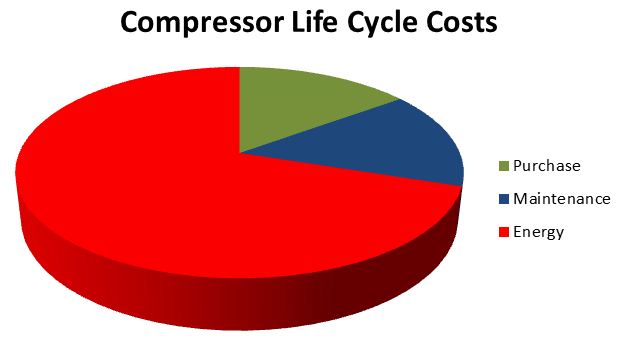
It is easy to see that energy should be a large consideration in most compressor choices; energy typically accounts for 70% of the lifetime costs of an air compressor.
1. Oil-Free or Lubricated
The first determination is whether the compressor should be lubricated, or “oil-free”. The vast majorities of compressors are lubricated. With proper air treatment, they can supply technically oil-free air that is suitable for painting, breathing, food processing, chemical, pharmaceutical and other sensitive requirements. Lubricated compressors provide the advantages of longer life, reduced cost, and increased energy efficiency compared to most oil-free compressors.
Certain chemical, medical, pharmaceutical and other industries are more comfortable with oil-free compressors. Even though purchase, energy, and maintenance requirements are significantly higher than lubricated machines, the perceived risk and consequences of oil contamination can be large enough to warrant the installation of an oil-free compressor system.
In large systems, requiring thousands of CFM, oil-free centrifugal compressors may be a viable choice even when oil-free air is not a stringent requirement. However, purchase and periodic maintenance costs may still be quite high.
2. Operating Pressure
Operating pressure is another prime concern. Typical tools and manufacturing operations require 80 to 100 PSIG, which can be achieved by most compressor designs. However, some systems operate higher to compensate for excessive pressure drop, undersized air lines, and pressure drop through air treatment devices. While you could simply purchase a higher pressure compressor to combat this, the best method is to reduce pressure loss to as great an extent as possible.
When using compressors with start/stop or load/unload controls, be sure to account for pressure differential between cut-in and cut-out pressures, as most compressors are rated at the maximum allowable pressure. For example, a compressor rated at 125 PSIG will typically vary pressure from 115 to 125 PSIG for a rotary compressor or 95 to 125 PSIG for a piston compressor. Lead/lag control of multiple compressors may also widen pressure band, requiring higher pressure compressors.
Certain pressure ranges are better suited to different compressor designs:

While it is critical to select a compressor with an operating pressure rating high enough to meet your needs and account for controls and losses, operating the compressor at as low a pressure as possible will keep energy costs low and reduce wear on the compressor.
Following is a simple formula for estimating the required maximum pressure of a new compressor:

Where:
Pcomp is the required compressor pressure
Pmin is the lowest allowable plant pressure
C is the number of compressors in the system
T is the number of treatment components (dryers and filters) that the compressed air will flow through
Pdiff is the control range, or switching differential of the compressor*
*if unknown, assume 10 PSIG for a rotary compressor or large reciprocating compressor, 30 PSIG for a small reciprocating compressor.
This equation assumes 5 PSID pressure drop over each dryer or filter, and a 5 PSI pressure setting stagger for lead/lag control of multiple compressors. These variables can be reduced by over-sizing treatment components and using master control systems (sequencers) in multiple compressor systems.
3. Capacity
Selecting the correct capacity compressor(s) is one of the most difficult aspects of selecting a compressor. An air survey is a good place to start for existing air systems when considering replacement, optimization, or expansion. Air surveys (sometimes called ‘audits’ or ‘assessments’) typically include supply side (air generation), demand side (air usage), or both.
Supply side audits evaluate air delivery of the air system, operating pressure, and power consumption over a given time frame. They use tools like flow meters, power meters, pressure transducers, and data loggers. At the end of a supply audit, you will know the quantity of air used and how much power is required. This process can identify inefficiencies and provide additional justification for compressor replacement through energy savings and energy supplier rebates.
Demand side audits typically evaluate the air distribution piping, identify air leaks, and evaluate the uses of compressed air for efficiency and alternatives. This may include measurement using point of use flow meters, pressure transducers at strategic locations, and ultrasonic leak detection equipment. At the end of a demand side audit, compression air reduction and operating pressure reduction opportunities will be identified.
After evaluating existing demand, future demand, and reduction opportunities, the usage profile can be evaluated, and the compressor(s) selected.
4. How Many Compressors?
Since air compressors typically provide such a critical system to manufacturing facilities, backup capacity is virtually a necessity. Traditional compressor systems often were comprised of one compressor sized to meet the full demand, and a backup compressor of the same size. In most applications, this meant that the compressor ran lightly loaded a large portion of the time. Depending upon the control method of the control, this setup may be very inefficient.
The recommendations suggest implementing an adequately sized backup compressor or retaining one from an existing system. Then, only use a single variable speed drive compressor to meet efficiency demand.
Often the best solution is a mix of compressors. If, for example, air demand ranges from 150 to 450 CFM, and backup is desired, selecting three 250 CFM compressors is often a good fit. Only one runs at low demand periods, the second runs during peak demands, and the third is held in reserve as backup. If using variable speed technology in a multi-compressor installation, it is typically recommended that only one compressor employ VSD. The others should operate either fully loaded or off. Using a master control system can coordinate the compressors with only minimal pressure fluctuation.
In any system with a backup compressor, it is imperative to operate the backup regularly. At least a couple of hours ensures the parts remain lubricated and the machine is functional when required.