
Exploring Air Compressors: Reciprocating Piston Compressors
There are many different types of air compressors. In fact for a more detailed breakdown of the different types read our Compressed Air 101: Types of Compressors. Every compressor model works slightly differently and has particular applications to which it is best suited. Compressor categories come from the method of air compression. The next few blog posts in this “Exploring Air Compressors” series will each focus on a different compressor category. Each post will explore the mechanics, applications, and common models of a particular compressor type.
Our series begins with the oldest type of air compressor: reciprocating piston compressor.
Reciprocating Piston Compressor

How does a reciprocating piston compressor work?
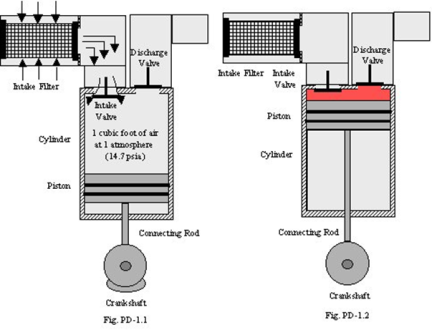
As one of the simplest and oldest methods of air compression, reciprocating piston compressors are quite ubiquitous. As the name suggests, these compressors use a moving piston to compress air. The movement of the piston shrinks the space around it, forcing the air into a smaller space. With less volume for the air to move around in, the overall air pressure increases.
Piston compressors can be either single acting or double acting, depending on the setup of the compression chamber. Single acting setups work by only drawing and compressing air in one section of the cylinder. The upstroke first draws air in, and then the downstroke compresses it.
Double acting setups allow for every stroke to compress air. As one section of the cylinder’s air is compressed, the other side takes in new air. When the stroke switches direction, the air that was just brought in, is now compressed. New air then enters on the other side. This setup is beneficial for creating more power and strength in a system.
What applications should use this?
Though technology has evolved greatly in the last 50 years or so, reciprocating piston compressors still tend to be the go to compressor for many uses. Many general-purpose applications for compressed air only require a reciprocating piston. Hobbyists, automotive services, and home workshoppers find piston compressors to meet their needs.
The relatively easy set-up of these machines makes maintenance and repairs relatively straight forward. There are not as many interconnected components as some other compressor models, and often units are less costly as well. However, reciprocating piston compressors are not suitable for all applications, and come with certain limitations, such as noise, that should be considered prior to purchase.
What reciprocating piston compressors are available?
Reciprocating piston compressors are generally smaller units, only reaching up to 60 Hp, with the typical range in the 2-30 HP.
CASCO USA stocks:
- Champion reciprocating compressors
- Anest Iwata
For more compressed air reading:
- Exploring Air Compressors Part 2, Rotary Screw Compressors
- Exploring Air Compressors Part 3, Scroll Compressors
- General Air Compressors info